
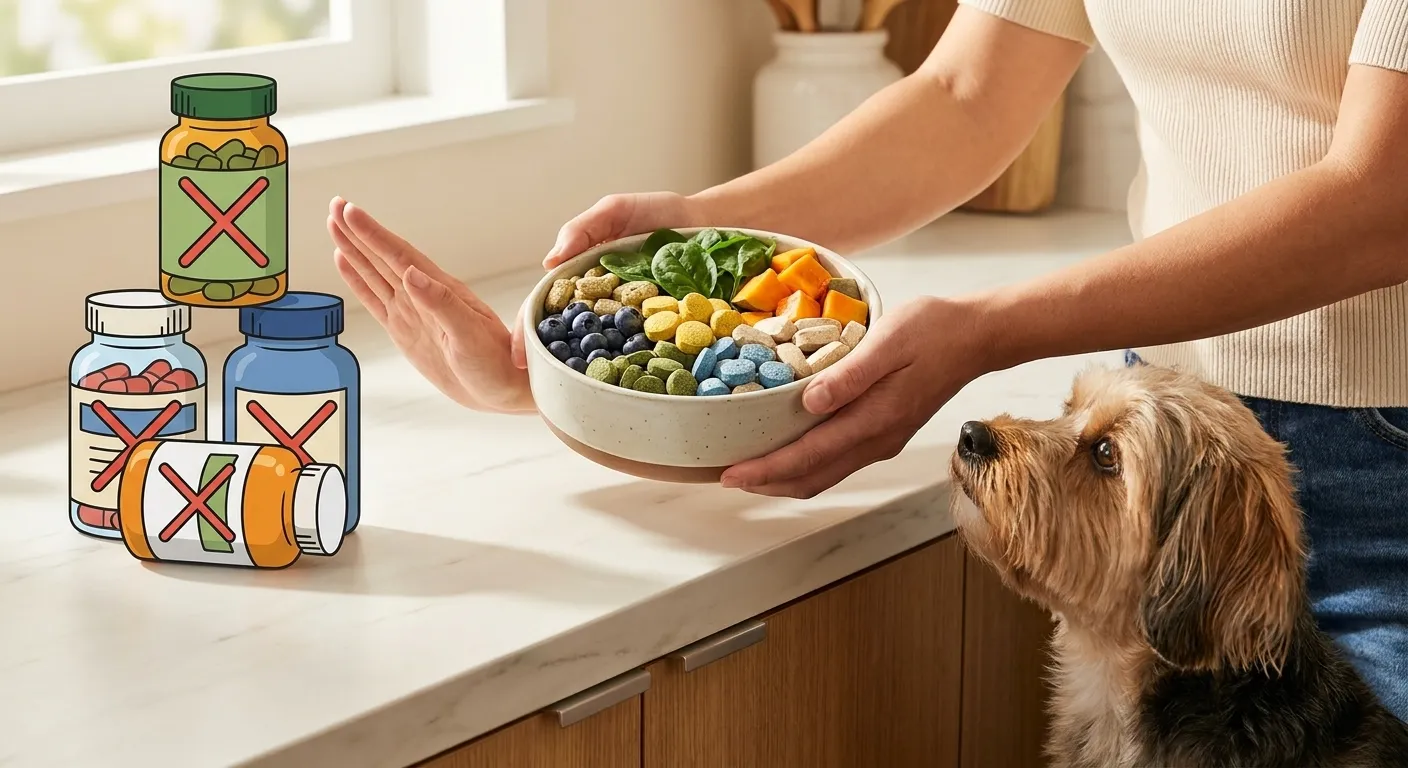
Getting pet supplement myths debunked is useful when it changes the questions you ask, rather than replacing one confident marketing slogan with another. This guide examines common shortcuts in shopping decisions and gives a practical check for each. It does not decide whether your pet needs a supplement or establish a dose. This is general educational information, not veterinary advice. Bring product questions and any health concern to your veterinarian; do not postpone assessment while trying to resolve a claim from a package or online review.
Myth: every pet needs a supplement for everyday wellness
A generic wellness message does not establish an individual need. Start by asking your veterinarian to review the actual feeding and care plan. Bring the main food label, treats, medicines, and every added product. The FDA’s explanation of complete and balanced pet food provides background on nutritional adequacy statements. It does not prescribe an addition for your pet. Read the statement and use it to ask a focused question instead of assuming that a marketing category identifies a gap.
Practical check: make two columns headed “reason being considered” and “information still needed.” A reason might be a question raised during a veterinary visit, not an invented diagnosis. Missing information might include the current formulation or the exact instructions. If the only reason is that a seller describes the product as essential, ask what evidence supports that description for the intended use. Keep no addition among the possible outcomes. You do not need to purchase something to complete a thoughtful feeding discussion.
Myth: natural is enough information to choose a product
The word natural does not answer questions about the complete formulation, intended use, administration, or your pet’s individual circumstances. Ask for the actual ingredient list and directions. Do not make a health or safety conclusion from the product’s visual style or an ingredient’s familiar name. Ask the veterinarian about the specific item alongside current medicines and other products. This guide is not declaring every natural product unsuitable; it is showing why that single word leaves the decision incomplete.
Practical check: circle descriptive words on the front panel and underline verifiable details elsewhere on the package. Keep those two groups separate in your notes. Ask the manufacturer for a legible label if the seller’s image is incomplete. If a blend uses a broad category rather than the identifying information you need, mark that as an unanswered question. Do not fill the gap with an ingredient amount from a different item. A calm request for documentation is more useful than a debate about the word natural.
Myth: a human supplement category proves a pet product is approved
The FDA explains that the human dietary-supplement law does not establish the same category for animal products. In the U.S., composition and intended use matter to the applicable animal food or drug framework. Do not read a familiar human supplement phrase as proof of a pet product’s approval or clinical usefulness. This is regulatory context, not a product endorsement. For an individual health question, bring the actual item and claim to your veterinarian.
Practical check: write the precise approval statement and ask what authority, product, and intended use it refers to. A statement about a facility is not necessarily a statement about the advertised health outcome. Request a direct official reference if a seller invokes a regulator. Do not transform vague language into a stronger claim while summarizing it for your family. Keep the seller’s statement separate from what you can confirm, and leave uncertain claims marked as uncertain in the comparison worksheet.
Myth: a glowing testimonial proves the product caused the change
An owner story may describe an observation without establishing its cause. Read for the sequence of events and other changes in food, treatment, activity, or environment. Ask whether the account is verified and whether a commercial relationship is disclosed. Do not invent missing dates or treat a polished photograph as evidence of the entire story. You can value another owner’s account while recognizing that it does not determine the appropriate choice for your pet or demonstrate an effect across animals.
Practical check: separate “what was observed” from “what the writer concludes.” Add a third column for missing context. A hypothetical account could include a supplement and a new care plan introduced in the same period; the story alone would not identify which element mattered. Use that example to clarify uncertainty, not as a fabricated case study. If you bring a testimonial to the veterinarian, explain which question it raised and ask how the evidence for the actual product compares with the anecdote.
Myth: more ingredients or a bigger number means a better choice
An expanding ingredient list does not tell you whether a formulation fits the intended purpose. Copy the complete list, stated amounts, units, and the label’s serving definition. Keep total product quantity separate from separately listed component quantities. Do not rank two packages by their largest front-panel number when those numbers may describe different things. Ask the veterinary team which information matters for the proposed use and whether there is enough documentation to assess the item. Avoid creating a dose by comparing packaging claims.
Practical check: build a side-by-side label sheet with one row per field, including product version and manufacturer contact. Mark missing information rather than assigning a score that conceals it. If the format or blend changes, obtain the current label. Do not use directions for one animal or product as a substitute for another. Your worksheet should help the clinician see the full proposed item; it should not turn a numerical comparison into an unsupervised administration plan.
Myth: a supplement routine should continue indefinitely
A repeating reminder is a household tool, not a continuing clinical recommendation. If your veterinarian recommends a product, ask for the purpose, instructions, review plan, and what would prompt earlier contact. Clarify refusal, missed administration, and an uncertain amount before they occur. Ask whether another care change affects the recommendation. Keep the exact formulation with the instructions so an automatic reorder does not quietly introduce a different item. A routine is useful only while it reflects the current assessed plan.
Practical check: place the review decision beside the administration record. At follow-up, ask whether to continue, change, or stop and update the shared care sheet. Bring observations and other changes without assuming the supplement caused every outcome. If you are concerned about your pet, contact the veterinary team instead of waiting for a planned review or a seller’s response timeline. Keep old instructions out of the active folder once the team changes the plan, while retaining a dated copy if useful for history.
Make a reusable claim-checking note
Choose one proposed product and summarize its actual label, intended purpose, source of the claim, evidence supplied, missing information, and question for the veterinarian. Keep this brief enough to review during an appointment. Do not give the product a positive or negative verdict merely because one field is incomplete; request the necessary clarification. Save the official reference for any regulatory assertion. This approach gives you a repeatable method for future claims while preserving the limits of what an owner can establish from advertising alone.
A practical next step
To put pet supplement myths debunked into practice, replace each shortcut with a specific question and the documentation needed to answer it. Review the individual feeding and care plan, keep the actual label visible, and follow veterinary instructions if a product is recommended. Clear records and honest uncertainty are more useful than swapping one sweeping promise for another.