
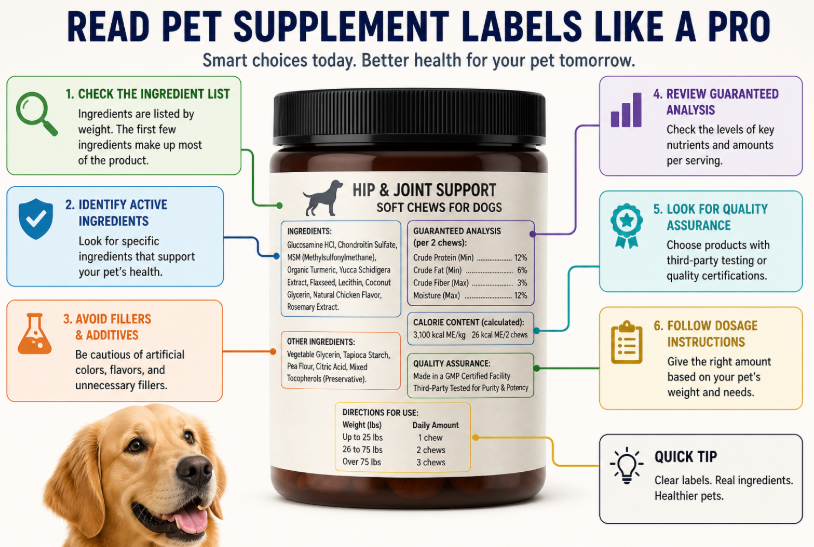
Learning to read pet supplement labels is one of the most valuable skills you can develop as a pet owner. While packaging often looks appealing and promises impressive benefits, the real truth lies in the fine print. Many products use clever marketing to stand out, yet they may not deliver real value. Therefore, understanding how to quickly interpret labels helps you make smarter, safer decisions for your pet’s health.
When you read pet supplement labels with confidence, you reduce confusion and avoid wasting money on ineffective products. More importantly, you protect your pet from unnecessary or harmful ingredients. With a few simple habits, you can turn label reading into a fast and reliable process.
Why Label Reading Matters More Than You Think
Many pet owners rely on brand names or reviews when choosing supplements. However, these factors do not always reflect actual quality. When you read pet supplement labels carefully, you gain direct insight into what your pet is consuming.
Labels reveal the ingredient list, nutrient levels, and formulation details. These elements determine whether a supplement is beneficial or not. Without this knowledge, it is easy to choose products that look good but lack real effectiveness.
Additionally, labels help you compare options quickly. Instead of guessing, you can evaluate products based on clear information. This approach saves time and builds confidence in your decisions.
Understanding The Ingredient List
The ingredient list is the most important section when you read pet supplement labels. It shows exactly what the product contains and in what order. Ingredients listed first are present in higher amounts, so they deserve the most attention.
Look for recognizable, high-quality ingredients. These often include well-known nutrients or natural sources that support specific health needs. On the other hand, long lists of unfamiliar additives may indicate lower quality.
Transparency is a key indicator. Products that clearly list their ingredients are easier to trust. When you read pet supplement labels and see vague terms, it may be a sign to look elsewhere.
Identifying Active Ingredients
Active ingredients are the components that provide real benefits. When you read pet supplement labels, focus on these first. They should be clearly identified and supported by appropriate dosage levels.
For example, if a supplement claims to support joint health, it should include ingredients known for that purpose. However, the presence of an ingredient alone is not enough. The amount included must be effective.
Low-quality products often include small amounts of active ingredients just for marketing purposes. Therefore, checking both presence and quantity is essential. This helps you avoid products that do not deliver results.
Spotting Fillers And Additives
Fillers and additives are common in many supplements. While some serve practical purposes, others offer no real benefit. When you read pet supplement labels, watch for unnecessary ingredients that may dilute effectiveness.
Artificial colors, flavors, and preservatives are often used to improve appearance or shelf life. However, they are not essential for your pet’s health. In some cases, they may even cause sensitivities.
Choosing products with minimal filler content ensures that your pet receives more of what actually matters. Clean formulations are usually easier to evaluate and more reliable over time.
Understanding Guaranteed Analysis
Guaranteed analysis provides information about nutrient levels. When you read pet supplement labels, this section helps you understand what your pet is actually getting.
It typically includes percentages or amounts of key nutrients. These values help you determine whether the supplement meets your pet’s needs. However, interpreting these numbers requires some basic understanding.
Comparing similar products can provide context. If one supplement offers significantly higher levels of a beneficial nutrient, it may be a better choice. This comparison becomes easier as you gain experience.
Checking For Certifications And Testing
Certifications and testing information add credibility to a product. When you read pet supplement labels, look for signs of third-party testing or quality assurance.
These indicators show that the product has been evaluated for safety and accuracy. This reduces the risk of contamination or incorrect labeling. As a result, you can feel more confident in your choice.
Reputable brands often highlight their testing processes. If this information is easy to find, it reflects transparency and reliability. Therefore, it is worth checking whenever possible.
Evaluating Dosage Instructions
Dosage instructions are another important part of learning to read pet supplement labels. They tell you how much of the product to give based on your pet’s size or condition.
Clear and detailed instructions indicate a well-designed product. On the other hand, vague or missing guidelines may signal poor formulation. Proper dosage ensures that your pet receives the intended benefits without risk.
Following these instructions consistently is essential. Even high-quality supplements can be ineffective if used incorrectly. Therefore, understanding this section is just as important as reviewing ingredients.
Recognizing Marketing Language
Marketing language can sometimes be misleading. Terms like “premium” or “natural” may sound appealing, but they are not always regulated. When you read pet supplement labels, focus on facts rather than claims.
Instead of relying on slogans, look at the ingredient list and nutrient information. These provide a clearer picture of the product’s quality. By separating marketing from reality, you make more informed decisions.
This approach also helps you avoid being influenced by packaging alone. Over time, you become more confident in identifying truly valuable products.
Comparing Products Quickly
Once you understand how to read pet supplement labels, comparing products becomes much easier. Start by looking at the top ingredients and active components. Then, review dosage and additional details.
This quick evaluation allows you to filter out weaker options. As a result, you can focus on products that meet your standards. With practice, this process becomes faster and more intuitive.
Keeping your pet’s specific needs in mind also helps. When you know what to look for, you can make decisions without hesitation.
Building Confidence Over Time
At first, learning to read pet supplement labels may feel overwhelming. However, with practice, it becomes second nature. Each time you review a product, you gain more experience and insight.
Start with simple comparisons and gradually build your knowledge. Over time, you will recognize patterns and identify quality more easily. This confidence allows you to make better choices without second-guessing.
Additionally, staying informed about common ingredients and standards helps you stay ahead. The more you learn, the easier it becomes to navigate the market.
Conclusion
Learning how to read pet supplement labels like a pro is a skill that pays off in both time and peace of mind. By focusing on ingredients, dosage, and transparency, you can quickly identify products that truly support your pet’s health. While the process may seem detailed at first, it becomes faster and more natural with practice.
Ultimately, understanding labels empowers you to make confident, informed decisions. This ensures that your pet receives safe and effective support without unnecessary risks. With a clear approach, you can navigate the world of supplements with ease and clarity.
FAQ
- What is the most important part of a supplement label?
The ingredient list is the most important, as it shows what the product actually contains. - How can I tell if a supplement is high quality?
Look for clear labeling, effective ingredient amounts, and third-party testing information. - Are all natural ingredients safe for pets?
Not always, as some natural ingredients can still cause issues if used incorrectly. - Why are fillers used in supplements?
Fillers are often used to reduce cost or improve texture, but they may not provide benefits. - How long does it take to understand labels well?
With regular practice, most pet owners become comfortable reading labels within a short time.