
Disclaimer: this is general information, not veterinary advice. We are pet parents and label-readers, not veterinarians or animal nutritionists. Talk to your vet before starting, stopping or changing any supplement.
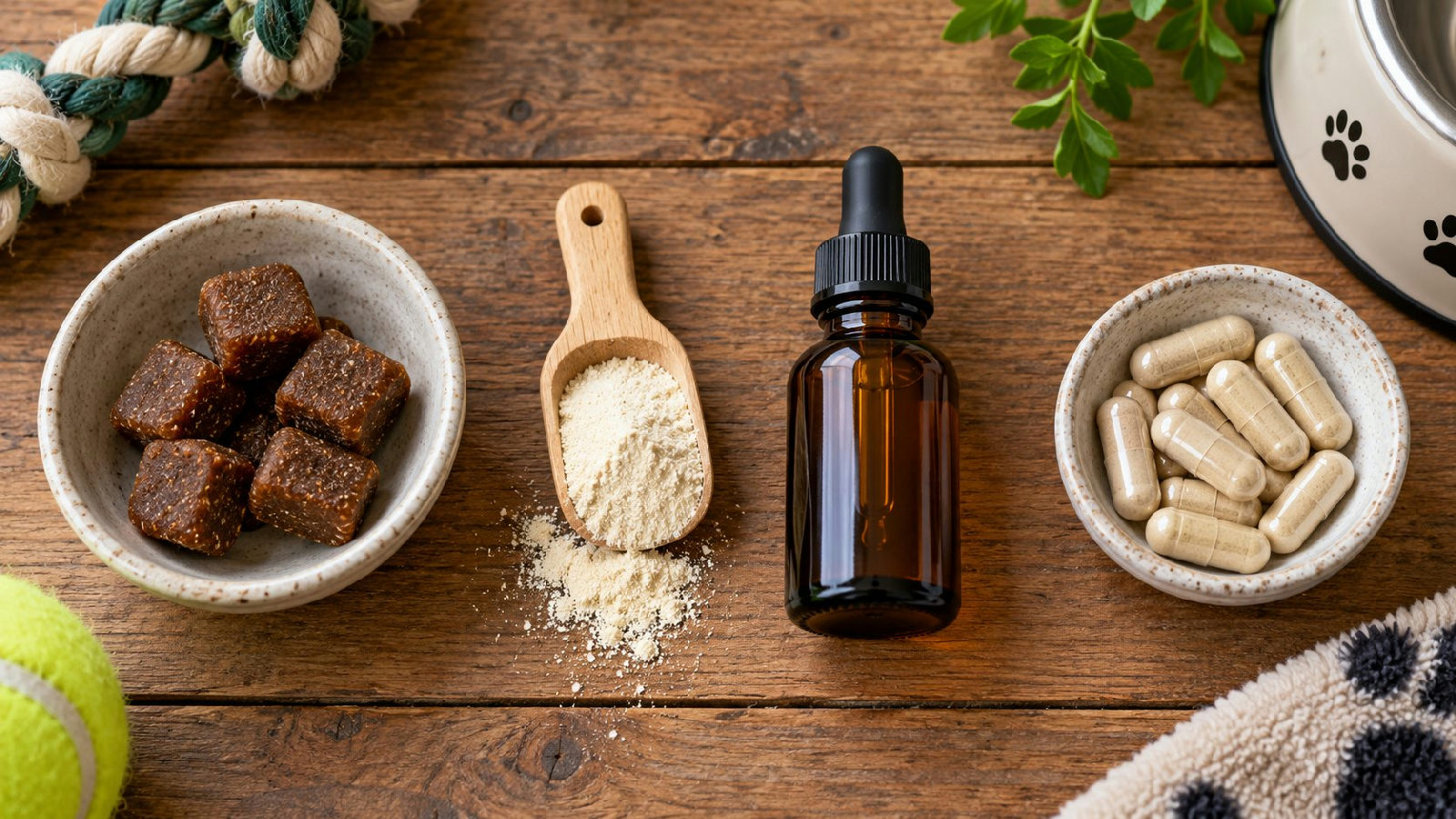
When you’re comparing pet supplement forms, start by writing down which forms your pet already accepts, then check the label of each option for what one serving is, the species and weight range it’s labelled for, and the inactive ingredients. Take that list to your vet and ask which form they’d suggest for your pet before you buy or switch.
If this page contains affiliate links, we may earn a commission at no extra cost to you.
We’re budget-first shoppers, so this guide is about the practical side: how to compare a soft chew, a scoop of powder, a dropper of liquid and a capsule on paper, what to note down at home, and which questions to bring to your vet or the brand. It isn’t a ranking, and we don’t name products or quote prices.
Start with your pet, not the product
Before you look at any tub or bottle, spend two minutes writing down how your pet behaves around food and treats. This short profile makes the conversation with your vet faster and keeps you from buying a form your pet won’t touch.
- Species, age and current weight (from your last vet visit if you have it)
- Does your pet take treats from your hand happily, or sniff and walk away?
- Does your pet finish every bowl, or leave food behind?
- Has your pet taken a pill, chew, powder or liquid before? Write down which, and how it went.
- Any foods or ingredients your vet has told you to avoid
- Everything your pet currently takes, including medications, treats and other supplements
- Other pets in the home who might get to the product
Keep this list on your phone. You’ll use it in every section below.
What to check on the label for every form
Whatever form you’re looking at, the same handful of label details let you compare like with like. Photograph the panel in the shop or zoom in on the listing images, and check the label for:
- The active ingredient name and the amount listed per serving
- What one “serving” is: one chew, one scoop, one dropper, one capsule
- The species and weight range the product is labelled for
- The inactive ingredients and flavourings
- Whether calories per serving are listed
- Storage directions and any “use within” note after opening
- A lot number, expiry date and a contact for the manufacturer
If any of those are missing, write “not on label” rather than guessing, and ask the brand. Our guide to reading pet supplement labels walks through each panel.
Pet supplement forms side by side: what to ask about each
Rather than tell you which form is better, here’s a set of questions for each one. Fill in the answers from the label, then take anything you’re unsure about to your vet or the brand.
Soft chews
- Check the label for calories per chew. If they aren’t listed, ask the brand.
- Write down how many other treats your pet gets each day.
- Ask your vet how a daily chew should fit into your pet’s treat allowance.
- Check whether the label calls the product a supplement or a treat, and note the exact wording.
- Read the inactive ingredients against any list of foods your vet has asked you to avoid.
- Ask the brand how the chews should be stored once the tub is open.
Powders
- Check the label for what one scoop contains, and whether a scoop is included.
- Write down the scoop size so you don’t mix it up with a scoop from another tub.
- Ask your vet whether the powder should go in a full meal or a small portion of food.
- Note whether your pet finishes the bowl. If not, write that down for your vet.
- Ask the brand whether the powder can be mixed with wet food, dry food, or both.
Liquids
- Check the label for the measuring device and the serving size in millilitres or drops.
- Note any “shake well” or “refrigerate after opening” directions.
- Ask your vet to show you how to give a liquid by syringe or dropper before you try it at home.
- Ask your vet or the brand whether the liquid can be mixed into food.
- Write down how long an opened bottle lasts according to the label.
Capsules and tablets
- Check the label for the number of capsules or tablets per serving.
- Ask your vet whether the product should be given with food or on an empty stomach.
- Ask your vet or the brand before you crush a tablet, open a capsule or mix it into liquid.
- If you plan to use a pill wrap or a bit of food, check its ingredients and ask your vet whether it counts toward treats.
- Write down whether your pet swallowed it, spat it out or hid it.
For background reading, Washington State University Veterinary Teaching Hospital publishes a page on giving oral medications to your dog. It’s a useful thing to read before your vet appointment so you know what to ask about.
Compare price per serving, not price per tub
As budget shoppers, this is where we spend most of our time. Tub size tells you very little. Here’s the routine we use:
- Write down the number of servings in the container, from the label.
- Write down the serving your vet has suggested for your pet, which may differ from the label.
- Work out how many days the container will last at that serving.
- Divide the total cost by the number of days to get a cost per day.
- Repeat for each form you’re considering, using the same active ingredient amount where you can.
If two products list the active ingredient in different units, ask the brand to confirm the amount per serving in a single unit before you compare. Our guide to choosing pet supplements has more on that label maths.
A copyable comparison sheet
Copy this into a note or print it out. Fill in one column per product you’re considering.
- Product form: chew / powder / liquid / capsule
- Active ingredient and amount per serving (as written on label):
- What one serving is:
- Species and weight range on label:
- Calories per serving (or “not listed”):
- Inactive ingredients to flag for my vet:
- Storage and “use within” note:
- Servings per container:
- Cost per day at my vet’s suggested serving:
- Lot number and expiry:
- Brand contact:
- Questions for my vet:
- Questions for the brand:
Matching form to your household
Use your pet profile from the first section to pick which questions to lead with at the vet:
- Treat-lovers watching their weight: ask whether a chew’s calories fit, or whether another form makes more sense.
- Picky eaters who sort food: ask whether a liquid given directly, or a capsule in a small piece of food, would be easier than mixing into the bowl.
- Pets on medication: bring the full list from your profile and ask your vet to check form and timing alongside it.
- Multi-pet homes: ask which form is least likely to end up in the wrong pet, and check the species on the label.
Your after-you-buy routine
Once you and your vet have picked a form, a simple routine keeps things on track for the first few weeks.
- Photograph the label panel, lot number and expiry date the day it arrives.
- Store it where the label says, closed and out of reach of pets and children.
- Write the start date on the container.
- Keep a short daily log (below) for the first two to four weeks.
- Bring the log and the photos to your next vet check-in.
Daily log template
- Date and time given:
- Form and amount given:
- Given with food, in a treat, or directly:
- Did your pet take all of it? (yes / partly / no):
- Appetite, energy and stool today (your own words):
- Anything unusual you noticed:
- Notes for your vet:
Writing it down beats relying on memory. If something changes, you’ll have dates and details ready for your vet instead of a rough guess.
When to call your vet
- Your pet seems unwell after starting any new product
- You’re thinking of switching from one supplement form to another
- Your pet regularly refuses, spits out or leaves part of a supplement
- You want to crush a tablet, open a capsule or mix a product into liquid
- Your pet coughs or gags while you’re giving a liquid
- Your pet’s weight is changing and chews or treats are part of the daily routine
- Your pet eats more than one serving or gets into the container
- For anything that looks serious or like poisoning, contact your vet or an emergency clinic right away, or the ASPCA Animal Poison Control Center or Pet Poison Helpline
Questions to ask your vet
- Which form would you suggest for my pet, and why?
- Should this be given with food or separately?
- Is it OK to crush, open or mix this product, or should it be given whole?
- How should a daily chew fit into my pet’s treat allowance?
- Could you show me how to give a liquid?
- Does this form need to be timed around any of my pet’s medications?
- What should I write down in my log, and when should I check back with you?
Further reading
For background reading, the World Small Animal Veterinary Association publishes a handout on feeding treats to your dog, which is worth reading before you ask your vet about chews.
- World Small Animal Veterinary Association: Feeding treats to your dog
- Washington State University Veterinary Teaching Hospital: Giving oral medications to your dog
Pick the form your pet will reliably take, compare price per serving, keep a log, and let your vet guide any change.